
Brand positioning is the place your brand occupies in the mind of your ideal customer, relative to everyone else competing for the same attention. The relative part matters: positioning is not how you see yourself, it is how your customers place you against their alternatives. It is comparative, not absolute.
Most businesses think they have a positioning. Ask them to describe it and they will tell you they are "the quality option", or "the friendly alternative", or "the agency that really listens". These are not positions. They are aspirations, and fairly common ones. Brand positioning is one of the most used and least understood terms in branding, so this guide explains what it actually means, why so many businesses get it wrong, and what strong positioning looks like in practice.
The short version
Positioning is what your brand does to the mind of your customer, not what you do to your brand. Good positioning is specific, honest, and sustainable. A business can believe it is premium and innovative and still have no positioning if none of that is registering distinctly with the people it is trying to reach.
What brand positioning actually means
Positioning is comparative. A business can believe it is premium, innovative, and trustworthy and still have no clear positioning if those claims are not registering distinctly in the minds of the people it wants to reach. The concept was introduced by Jack Trout in 1969, developed with Al Ries through their 1972 Advertising Age series "The Positioning Era Cometh", and set out in full in their 1981 book Positioning: The Battle for Your Mind. The core idea has not changed: "positioning", in their words, "is not what you do to a product. Positioning is what you do to the mind of the prospect."
“Positioning is not what you do to your brand. It is what your brand does to the mind of your customer.”
Why most businesses get it wrong
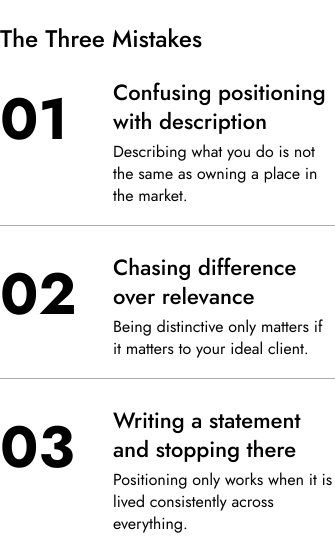
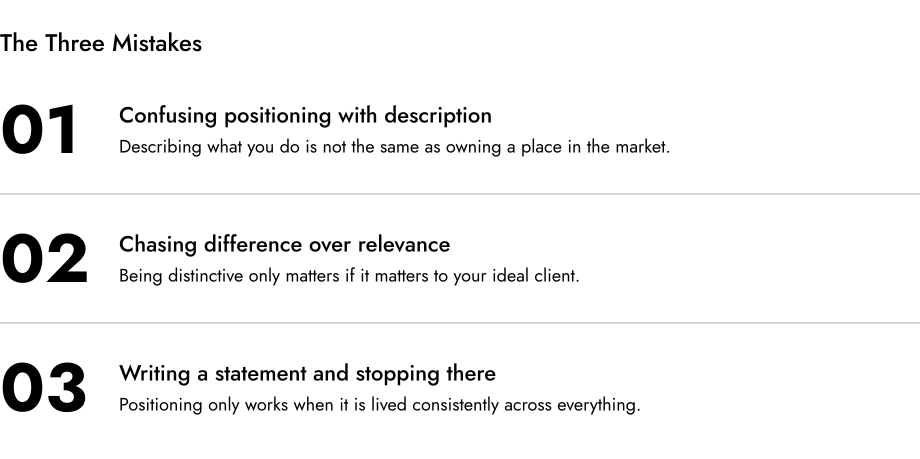
Three mistakes come up repeatedly.
Confusing positioning with description. "We provide high-quality branding for ambitious businesses" describes what you do; it gives the customer no reason to choose you over the next agency making the same claim. Positioning answers a different question: not what do you do, but where do you sit, and why does that matter to this specific person?
Chasing difference for its own sake. Difference without relevance is just noise. Being the only agency using a particular methodology is only meaningful positioning if your ideal clients care about it. Relevance matters more than uniqueness.
Writing a positioning statement and stopping there. A statement is a useful internal tool, not the same as having a position. Positioning only works when it is lived consistently, in every interaction, every proposal, every piece of content. A statement nobody references is not positioning. It is filing.
What strong brand positioning looks like
Three qualities are worth using as a test.
| Quality | The test |
|---|---|
| Specific | Does it name the customer, situation, and outcome precisely enough that the wrong prospect self-selects out? |
| Honest | Is it grounded in something you genuinely do better, not something you hope will one day be true? |
| Sustainable | Is it rooted in something structural (a method, a perspective, a mix of capabilities) rather than a person, trend, or copyable feature? |
Vague positioning is no positioning. "We help businesses grow" could describe almost any agency, consultancy, or software platform. Positioning that overpromises creates a gap between expectation and experience, and that gap is where trust breaks down.
Positioning in a market where everyone looks the same
The clearest test of positioning is a commoditised market. When we worked with Nationwide Conveyancers, the challenge was exactly that: a crowded market where most providers look and sound the same, generating leads but struggling to convert them. The positioning work was about giving the right clients a reason to choose them over the next identical option. We faced a related brief with Mural Crown, repositioning a wealth-management firm to reach a broader audience without losing the trust of the clients it already had. In both cases, positioning was what turned visibility into preference.
What a brand positioning statement looks like
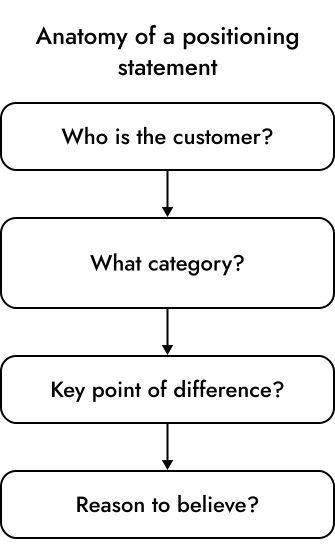
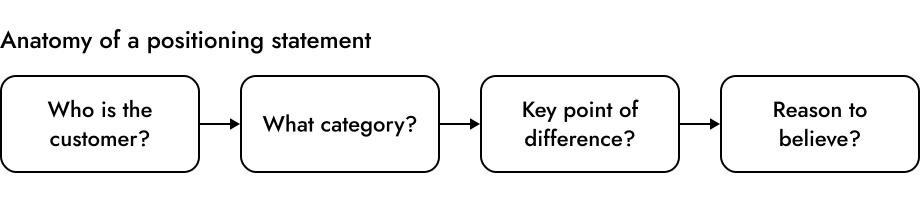
A positioning statement is a short internal document that answers four questions: who is the target customer, what category does the brand compete in, what is the key point of difference, and what is the reason to believe that claim? It is not a tagline or marketing copy; it is a decision-making tool.
"For ambitious businesses that want to grow, we are the branding agency that combines strategic thinking with creative execution" tells you almost nothing. "For professional-services firms in the UK that have outgrown their founding brand and need to attract higher-value clients, we are the branding and design agency that specialises in rebuilding brand credibility at growth stage" is actually useful.
How positioning connects to brand strategy
Positioning is one component of a broader brand strategy, and often the most commercially important one. Where strategy covers the full picture of who you are and what you stand for, positioning answers the narrower question of where you sit relative to competitors. You cannot have a coherent strategy without it, and positioning without the strategic foundations around it tends to drift as the business grows.
Repositioning, worth noting, is not the same as rebranding. A business can shift its position with new messaging and a clearer articulation of its ideal client without touching the visual identity, and a full rebrand that does not address the underlying positioning is unlikely to move the needle. Once you understand what positioning is, the next step is building one: our guide to brand positioning strategy covers how to find a position worth owning and hold it over time.
Sources
Al Ries and Jack Trout, Positioning: The Battle for Your Mind (McGraw-Hill, 1981), the text that coined and formalised modern positioning; history of the concept.
American Marketing Association, on branding and positioning.
Positioning in practice: Nationwide Conveyancers and Mural Crown, Saint Associates.