
The short version
A messaging framework has four core parts: the proposition, the value pillars, the tone of voice, and audience messaging. It is an internal tool; the copy and campaigns are the output. Most messaging problems are actually strategy problems, so the words are usually the last thing that needs fixing.
What brand messaging actually is
Brand messaging is the verbal expression of a brand's positioning, values, and personality. A brand without clear messaging sounds different every time you meet it, switching between authoritative and casual and hedging depending on who wrote the particular piece of copy. The cumulative effect is that no impression sticks and no trust builds. A brand is what people say about you when you are not in the room, and inconsistent messaging ensures they say nothing very definite.
The parts of a brand messaging framework
Frameworks vary, but the most useful ones share the same core elements.
| Element | What it is |
|---|---|
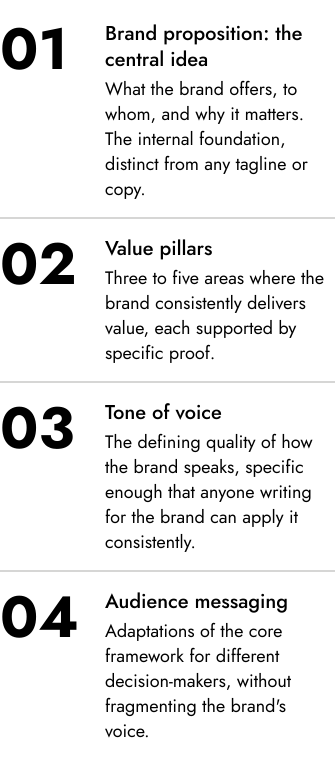
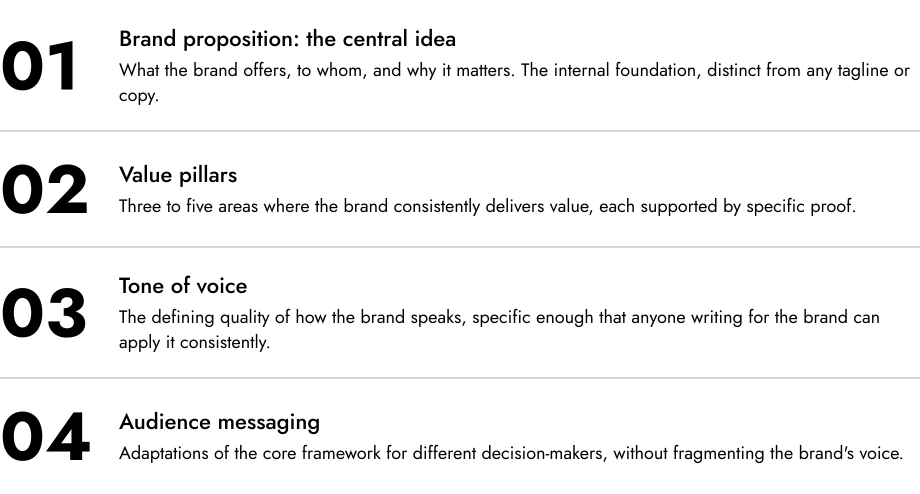
| Brand proposition | The clearest statement of what the brand offers, to whom, and why it matters. The internal foundation everything else is built on, not a tagline |
| Value pillars | Typically three to five areas where the brand consistently delivers value, each backed by real proof |
| Tone of voice | How the brand speaks across every message, defined specifically enough that anyone writing for the brand can apply it |
| Audience messaging | How the core framework flexes for different people, without fragmenting the brand's voice |
The brand proposition is the central idea, grounded in a clear sense of the positioning and the values that sit behind it.
The value pillars sit beneath it, each supported by proof, whether specific examples, outcomes, or credentials, so the claim is real rather than aspirational.
The tone of voice is what makes a brand recognisable in voice as well as appearance. The same information can be delivered in ways that feel authoritative or approachable, formal or direct.
Audience messaging adapts the core framework for different people. A CFO and a marketing manager are both decision-makers, but the language that makes a CFO lean in is not the language that moves a marketing manager. Good messaging acknowledges that without splintering the brand's voice.
“The framework is internal. The output, the copy, the campaigns, the conversations, is what the audience sees.”
Why messaging fails
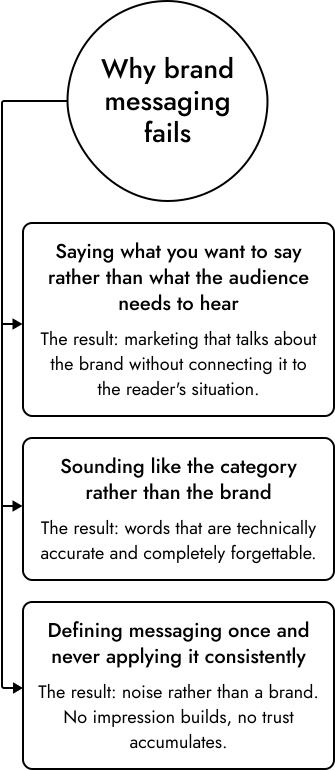
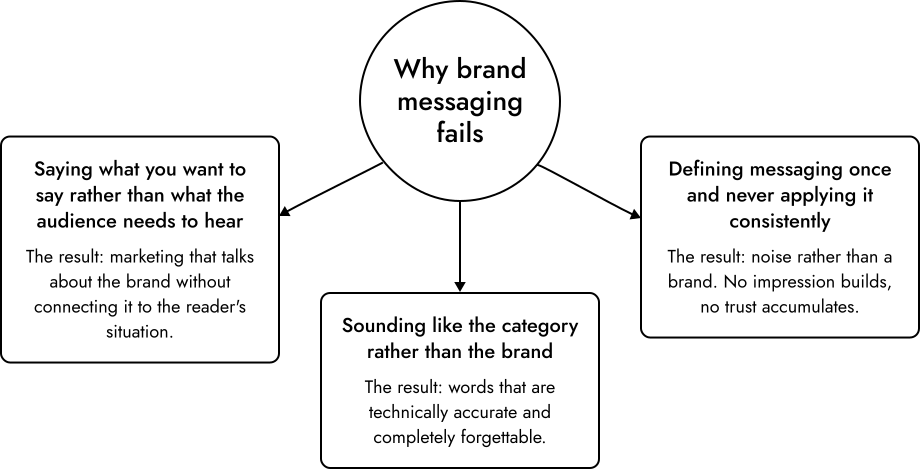
Three failure modes account for most of it.
The first is messaging built on what the business wants to say rather than what the audience needs to hear. It reads as self-referential: lots of "we" and "our", very little that connects to the reader's actual situation.
The second is messaging that sounds like the category rather than the brand. When every agency promises "strategy and creativity", and every professional-services firm promises to be a "trusted partner", the words stop carrying meaning. Blending into the language of the category is the messaging equivalent of blending into the market: invisible and forgettable.
The third is inconsistency. Messaging defined once and then ignored, or defined in one place and never applied elsewhere, produces noise rather than a brand. Consistency, sustained and frequently underestimated, is what turns a message into a reputation.
Developing messaging that holds
Effective messaging is built from the strategy down. Without a clear grasp of positioning, audience, and values, messaging exercises tend to produce copy that sounds plausible but carries no conviction. In our experience most messaging problems are strategy problems in disguise; the words are usually the last thing that needs fixing.
From that foundation you build the framework, the proposition, the pillars, the tone, the audience adaptations, then test it against real commercial contexts. Does this language land in a pitch deck? Does it hold up in a LinkedIn post? Does it feel true in a difficult client conversation, not just when everything is going well?
When we rebranded Stilwell Grey into Vantage Accounting, the tone of voice was developed alongside the name and identity, so the business sounded as approachable and clear as it now looked. When we named and launched Contour, an invite-only leadership club, the messaging work defined a personality (confident, grounded, challenging) that now sits behind every line of copy. The measure of good messaging is whether it builds recognition and trust across repeated encounters, in different contexts, over time. Sounding impressive in isolation is a low bar.
“Most messaging problems are strategy problems. The words are usually the last thing that needs fixing.”
Sources
Slogan histories: Nike's "Just Do It" (1988) and Tesco's "Every little helps" (1993), Creative Review.
Messaging in practice: Vantage Accounting and Contour, Saint Associates.